WHY TECHNICAL SKILLS MAY NOT BE ENOUGH TO PROMOTE MENTAL HEALTH IN THE WORKPLACE
Modern organizations increasingly recognize workers’ mental health as an important factor in productivity and quality of work, with HR professionals playing a crucial role in implementing policies, procedures, and tools aimed at maintaining and improving their mental health. However, research suggests that technical skills alone, although necessary, may not be sufficient to effectively address mental health issues that workers may experience.
Technical skills include knowledge and understanding of the legislative framework, psychosocial risks, and methods of their assessment, as well as monitoring indicators such as sick leave, turnover, and work performance. Such skills enable a structured approach to mental health management, but they alone may not guarantee a safe and supportive work environment. Studies suggest that organizational factors and interpersonal relationships have as strong an impact on workers’ mental health as formal policies and procedures.
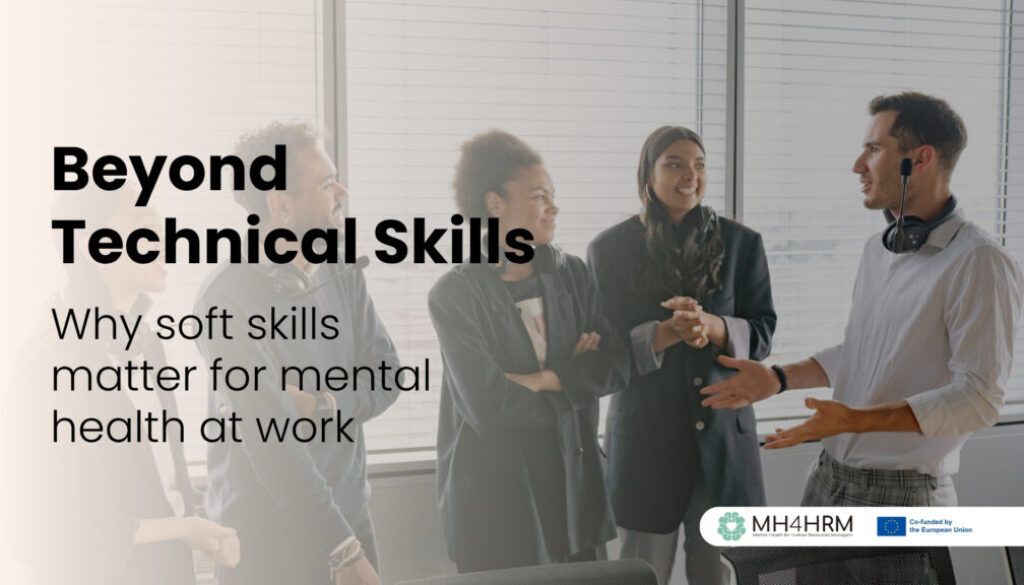
Workplace mental health is largely shaped by everyday interactions. HR professionals are often the first contact point for workers dealing with stress and mental health challenges, where soft skills such as communication, empathy, active listening, and emotional intelligence play a crucial role. Research shows that workers seek support more often and report difficulties earlier in surroundings where they feel safe and heard. Furthermore, HR experts with developed interpersonal skills are more likely to recognise early signs of psychological stress and react in a timely manner through adjusting working conditions, mediating with management, or referring workers to appropriate forms of support. Without these skills, technical tools and procedures may remain unused or be used only when the problem has already developed significantly.
Additionally, beyond the individual level, HR’s soft skills strongly influence organisational culture. The way HR communicates and resolves conflicts shapes the level of trust and psychological security in the organisation.
Therefore, maintaining mental health in the workplace requires an integrated approach. Technical HR skills provide structure, alignment, and measurability, while soft skills enable their effective application in real-world work surroundings. The development of both sets of competencies is essential for HR professionals to be able to respond to the challenges of workers’ mental health. That’s why the MH4HRM was developed – to provide HR professionals with practical tools and educational resources to support both technical and soft skill development.
References:
- Edmondson, A. (2018). The Fearless Organization. Wiley.
- Edmondson, A. C., & Lei, Z. (2014). Psychological safety: The history, renaissance, and future of an interpersonal construct. Annual Review of Organizational Psychology and Organizational Behavior, 1, 23–43.