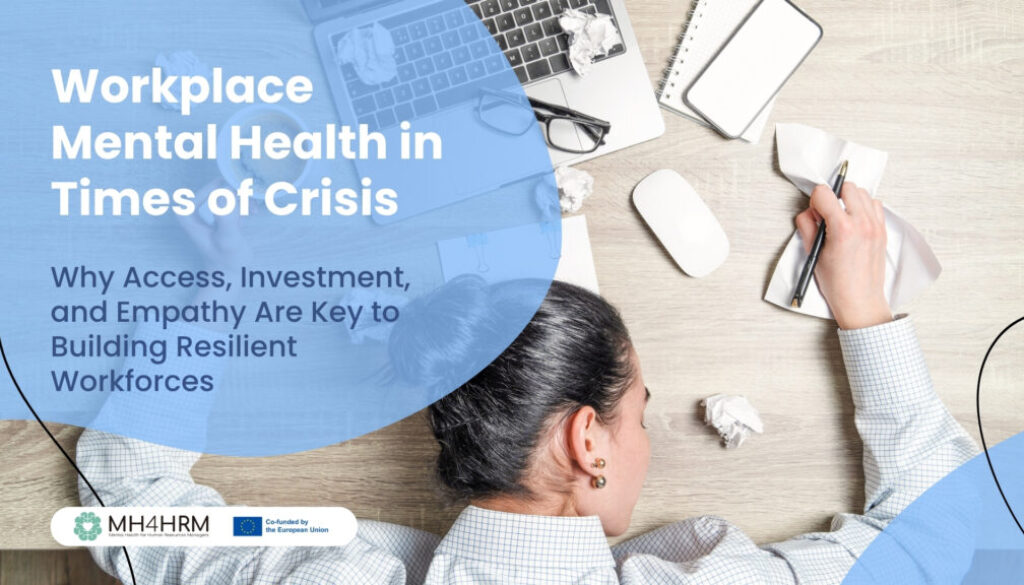
Mental health at work: A global call on world mental health day
Every year on October 10th, the world comes together to raise awareness about mental health. In 2025, World Mental Health Day focuses on the theme: “Access to services: mental health in catastrophes and emergencies”. While this highlights the need for support in crisis contexts, it also resonates deeply with the challenges faced in today’s workplaces.
Why Mental Health at work matters
Mental health in the workplace is a cornerstone of collective well-being. Yet, over 84 million people in the EU experience mental health issues, and work-related stress is one of the leading contributors. According to the European Trade Union Institute, workplace stress causes over 10,000 deaths annually in Europe—more than physical workplace accidents.
High workloads, job insecurity, lack of autonomy, and workplace harassment are key factors driving psychological distress. Sectors like healthcare, education, and customer service are particularly affected.
Gaps and inequalities
Despite growing awareness, access to mental health support remains limited. In many European countries, less than 30% of employees have access to psychological support at work, and public investment in mental health accounts for just 2% of total health spending, far below the recommended 5%.
Small and medium-sized enterprises (SMEs) often struggle to implement support measures due to limited resources, creating a gap between large corporations and smaller businesses.
Initiatives making a difference
Some organizations are leading the way:
- Enel (Italy) has introduced mental health first aid programs, flexible work options, and awareness campaigns like Break the Stigma.
- France implemented the Right to Disconnect Law, protecting workers from digital stress outside working hours.
- The European Commission launched a comprehensive strategy in 2023 with 20 initiatives and €1.2 billion in funding to improve access to mental health services.
Moreover, the OECD estimates that every euro invested in mental health yields up to €4.70 in social and economic return, reinforcing the case for increased public investment.
Looking ahead
This October 10th, the message is clear: mental health must be a priority in every workplace, especially in times of crisis. Building empathetic organizational cultures, investing in prevention, and ensuring access to adequate services not only improves workers’ lives—it strengthens the resilience of our societies.
References
World Federation for Mental Health. (2025). Access to services – Mental health in catastrophes and emergencies [Fact sheet]. World Mental Health Day 2025. https://wmhdofficial.com/wp-content/uploads/wmhd-2025-document_v01.pdf
European Trade Union Institute. (2025, April 28). Workplace stress epidemic killing 10,000 people a year. European Trade Union Confederation. https://www.etuc.org/en/pressrelease/workplace-stress-epidemic-killing-10000-people-year
Organisation for Economic Co-operation and Development (OECD). (2024). Mental health promotion and prevention. https://www.oecd.org/en/publications/mental-health-promotion-and-prevention_88bbe914-en/full-report.html
European Parliament. (2025, May 19). Improving mental health at work [At a glance briefing]. European Parliamentary Research Service. https://www.europarl.europa.eu/thinktank/en/document/EPRS_ATA%282025%29772868
Mental Health Europe. (2023, December 14). Briefing on recent EU policy developments on mental health [Policy document]. https://www.mentalhealtheurope.org/library/briefing-on-recent-eu-policy-developments-on-mental-health/