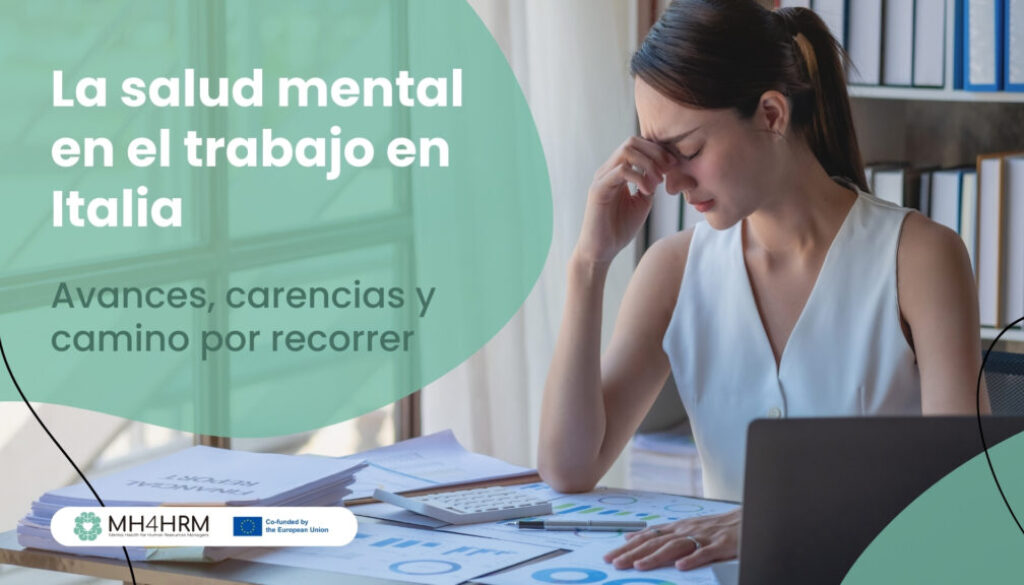
Salud mental en el trabajo en Italia: avances, carencias y perspectivas
In recent years, mental health in the workplace has become an increasingly important topic in Italy, especially in the aftermath of the COVID-19 pandemic – which brought a sharp rise in stress, burnout, and psychological distress among employees across the country. According to Altilio et al. (2025), 46% of Italian workers reported increased work-related stress.
Despite the growing concerns, support remains limited: only 33% of Italian employees are consulted about stressful aspects of their job, 37% receive any form of training on well-being, and just 29% have access to psychological support – all figures falling below the EU averages. Sectors already under intense pressure, such as healthcare, education, and customer service, are particularly affected. And although awareness is on the rise, stigma around mental health continues to prevent many from seeking help.
One major barrier is underfunding. Mental health services in Italy currently receive just 3.4% of the national health budget – far below the European average of 5%. And yet, the OECD estimates that every euro invested in mental health returns €4.70 in societal and economic value (Angelini Industries, 2023). A powerful argument for increasing public investment.
In response to this, several initiatives have been introduced. One example is the “Psychologist Bonus” (Bonus Psicologo), introduced in 2021 and made permanent in 2023 – providing financial assistance for psychotherapy to individuals with an ISEE (Equivalent Economic Situation Indicator) below €50,000. On the legislative side, laws such as the Workers’ Statute (Statuto dei Lavoratori) and Legislative Decree 81/2008 place a legal obligation on employers to assess psychosocial risks and take preventive action (INAIL, 2022).
Some employers are responding proactively. Enel, one of Italy’s leading energy firms, has introduced measures including mental health first aiders, flexible work options, and awareness campaigns. Their “Break the Stigma” program promotes open dialogue about well-being and supports employees in managing their mental health (Enel, 2023). Enel’s effort in this space is setting a positive example for other organizations to follow.
However, the implementation of mental health support remains uneven across the private sector. Larger firms are generally leading the way, while smaller enterprises often struggle to provide the same level of care due to limited infrastructure or funding.
Looking ahead, continued progress will depend on closing this gap. Every worker – regardless of the size of their employer or the sector they work in – deserves meaningful, accessible mental health support.
References
Altilio, C., Caneve, S., Fiore, I., Porcheddu, D. & Roiatti, M. (2025) National Highlight – Italy
Deliverable 2.1. https://www.adapt.it/wp-content/uploads/2025/04/NH_Italy_ENG_10_4_25.pdf
Angelini Industries. (2023). Mental health: A strategic priority for a country’s future. https://www.angeliniindustries.com/en/stories/health-journeys/mental-health-a-strategic-priority-for-a-countrys-future/
INAIL. (2022). Rischio stress lavoro correlato. https://www.inail.it/portale/ricerca-e-tecnologia/it/ambiti-di-ricerca/area-salute-sul-lavoro/rischi-psicosociali-e-tutela-dei-lavoratori-vulnerabili/rischio-stress-lavoro-correlato.html
Enel. (2023). Integrated Annual Report 2023. https://www.enel.com/content/dam/enel-com/documenti/investitori/informazioni-finanziarie/2023/annuali/en/integrated-annual-report_2023.pdf